Showing posts with label poverty. Show all posts

Wednesday, February 6, 2013

Jon Stewart Exposes the Hypocrisy of Rhee & Students First


“Radical” Michelle Rhee has been on a real PR push leading up to and immediately following the release of her new book Radical: Fighting to Put Students First.  She’s speaking at the Free Library of Philadelphia tonight to a sold-out crowd who will no doubt eat up each vague generalization that she makes about teachers and students and every misguided assertion about how to reform education that she spews.

And who can blame this audience for their acceptance of and even reverence for her words? She’s an intelligent, well-spoken woman with a compelling narrative, who presents herself as an expert on the shortfalls of urban schools.  However, what makes her so compelling to so many people is that unlike many educational historians and scholars, she doesn’t get caught up in all the messy talk about poverty, funding, and lack of resources and instead proposes a “solution”.  She is also quick to point out the people get in the way of her “solution”. Her appeal stems from her ability to lay out educational reform as a binary - either you are a Reformer who puts students first or you are Anti-reform and don't care what's best for children.  

I have written before about Michelle Rhee and how there was a time when I too thought, “hey, at least she’s doing something”.  It wasn’t until I started working and living in an urban district and researching urban education that I realized the systemic and intractable forces at work in large city schools.  Putting aside the DC cheating scandal and Students First’s political ties & support, I see Ms. Rhee’s reform agenda as being terribly short-sighted and ignorant of the inequities and realities that will continue to plague urban districts if they aren’t addressed at a systemic level. 

This came to the forefront in her interview with Jon Stewart on the Daily Show on Monday night.  Say what you will about the biases and leanings of Jon Stewart or the fact that his show is preceded by some of the dumbest programming on television (though for some reason I find Workaholics to be hilarious), he did what interviewers almost never do when sitting across from Michelle Rhee: challenge her. 

At first, after watching the five minutes or so that aired on TV, I was concerned that this was going to be just another venue for her to push the message that she’s the only one out there who really cares, she’s putting students’ interests first, blah, blah, blah.  She made her typical statements like, “If bringing common sense to a dysfunctional system makes me radical, then I guess I am and maybe more people should be radical” and “I come from teachers, that’s why I have an incredible regard for what they can do”.  Too many so-called reformers get away with making empty statements like these.  It’s like saying, “I spend time around doctors and I know they work hard, so I can tell them how to best perform surgery” or “I’ve been going to the dentist all my life, so I’m an expert of orthodontia”. 
 
But Jon Stewart came through for me in a big way.  Towards the end of the broadcasted portion of the interview and certainly in the extended version posted online, he did a powerful job pushing her to be specific and addressed much of what her "brand" of reform ignores. 

In one exchange Rhee referred to teachers as the greatest tool to improving student achievement.  Stewart replied, “That’s true, but teachers are the only tool that gets yelled at.  Teachers are the only tool we look at and say ‘fix it or you’re fired’”.  Stewart’s response demonstrates the inherent hypocrisy and disconnect in the corporate reform model.  You can’t argue that on one hand teachers are the greatest tools to improving achievement and have the greatest impact and need to be supported, but then on the other hand portray them as lazy and needing to be threatened into doing their jobs.  Corporate reform seems to have a paradoxical view of teachers as incredibly powerful and important, but ultimately inept. 

Stewart also pushed her to address some of the social and environmental realities facing urban schools. 
She replied: “Does poverty matter? Absolutely. I mean that makes it much more challenging… To escape poverty, we know the best way to do that is through education”.   
Stewart offered a simple but powerful reply, “Education can only take root if the soil is fertile”

This short exchange gets to the heart of what’s absent in her reform agenda: the structural forces that have a profound effect on academic and educational success. Yes, in a perfect world all the social programs would work together and every student would get the support they need so schools can focus all their efforts on academic success (actually, I’m not so sure that’s my idea of a perfect school… but anyway). Those in schools everyday know that’s not the reality , especially not in urban schools.  Students are hungry, they’re homeless, they’ve experienced major trauma, they’re sick, they have emotional or behavioral disorders, or they have undocumented learning disabilities. To ignore these realities is hardly putting students first. In fact, to expect a child who is hungry or in extreme emotional distress to sit through a two-hour math lesson or to take a standardized test seems cruel and unrealistic.  

Near the end of the interview the two have another great exchange that I’d like to highlight:
     Stewart: Have we abandoned the model of public schooling?  Especially in urban environments
     Rhee: No family should feel like they’re trapped in a failing school
     Stewart: Doesn’t public school become a repository for worst, most troublesome students?...
     Stewart: Your solution is if a school is failing, why not give students an alternative that works. But if you know how to create an alternative that works, why not offer that to the entire system and address the larger problems?

What Jon Stewart is pointing out is one of the major holes in the corporate reform movement: it focuses so much on individual schools and eliminating bureaucracy (which I will admit is exhausting), that it ignores the need for systemic change and even ignores the need for a system at all.   

Further, this whole reform ideology relies on “FAILING schools” to demonstrate the need for charters & vouchers so they can  swoop in and save the day.  It’s like waiting for a person to drown before you throw them a life preserver.  If reformers like Rhee have the solution, why aren’t they sharing it or putting it out there? Why are they sitting back and waiting for more and more students and schools to drown?  

This question harkens back to Diane Ravich’s “challenge” to KIPP to take over an entire district.  Her argument was, if you are having so much more success than the public schools and your model is so groundbreaking, let’s see it in practice.  Take over a district and show them how it’s done.  Of course, KIPP’s reply was essentially ‘that’s not what we do’.  

Rhee tried to wrap up by casting herself as a savior who’s not only putting students first, but also trying to support teachers (though she’s been pretty clear that if you recognize teachers’ needs, you aren’t putting “students first”). Fortunately, Jon Stewart refuses to let her use his show as a soapbox. 
     Rhee: We need to free teachers to be innovative & respond to students’ needs. This dysfunctional bureaucracy that’s driven by these antiquated policies.  Let’s change the laws and policies so they don’t stymie the educators into having to do things in a certain way. Let’s free them up to be able to do what they know is right for kids.
     Stewart: But isn’t that the antithesis of the testing regime?
     Rhee: No. We must have measures by which we understand whether or not kids are learning appropriately. 
     Stewart: The entire system of that metric is somewhat broken.
     Rhee: We should be always working towards finding better assessments.
                                                                                                                                              

So there you have it.  Apparently fixing our education system is that easy:
 - Ignore students’ realities
 - Label & close schools
 - Open new schools that can remove “problem students”
 - Test the hell out of kids
 - Vilify, intimidate, and terrify teachers
 - Make them compete for what slim resources remain
 - Tell anyone who doesn’t agree with you that they are selfish and don’t put “students first”
 - Write solipsistic memoir
 - Collect a big fat paycheck & look for a fancy private school for your own children

Tuesday, October 16, 2012

My Letter to President Obama

A few weeks ago, I read a post on Diane Ravich’s blog that suggested a campaign to write letters to President Obama on October 17th.  The goal of these letters is to share our experiences as educators or parents with the President, to show him the effect that his administration’s educational policies (or lack thereof) have had. The campaign was suggested by another outstanding blogger, Anthony Cody.

Below is a copy of the letter that I submitted to the President.  


Dear President Obama,

I strongly supported you in 2008 and I continue to support you in 2012; however, your record and your policies on education give me pause.  Unlike Governor Romney, who by all accounts views public education and teachers with contempt, you have expressed some interest in preserving and improving our nation’s democratic educational system.

Unfortunately, the rhetoric and lip service that you pay public education and teachers has not been matched by the policies of your administration.  As a result, I am left wondering if there is any hope for a truly democratic educational system that affords all students, no matter what neighborhood they live in or what their family circumstances, an opportunity for an equitable education.  

I teach in Philadelphia, a city that has struggled with violence, concentrated generational poverty, unemployment, and inequality for decades.  Further, I teach students who are over-aged (16-21 years old) and under-credited (having fewer than 12 of the 23.5 credits necessary for graduation). My students are teen parents, foster kids, victims of violence, and full-time workers.  They have struggled with abuse, seen expulsion from “no excuses” charter schools, and been incarcerated.   My students have been labeled dropouts, failures, and delinquents. In spite of these myriad mistakes and roadblocks, my students come to school everyday with more energy, determination, and drive than any I’ve experienced in my entire educational career. 

I share this description of my specific population to demonstrate the importance of alternative programs.  Unfortunately, programs like this are a dying breed. They are an easy target for budget cuts.  Every spring, my colleagues, students, and I wait with bated breath for the District’s decision about the fate of our school. Two years ago, we have saw our doors shuttered, only to be reopened months later after being used as political leverage. However with the mobility and fragility of our population, this experience served as the final blow for nearly one third of our students. 

Our precarious position is a direct result of growing privatization in the educational system. Coincidently, this same privatization is the exact reason that the waiting list for my program continues to grow each passing semester. 

Privatization within public education is systematically undermining our nation’s democratic educational ideal by siphoning resources from public schools and communities.  Additionally, this system of privatization has created a two-tiered reality of education in large urban districts, affording a select few students a high caliber education, while the majority of students are forced to cope with under-funded and dilapidated schools. 

More troubling even than the inequitable system created by privatization is the proliferation of for-profit schools.  In Philadelphia alone, we’ve seen a staggering number of cases of fraud coming from charter and cyber schools that promise parents and children better opportunities, only to take the money and run.  When education becomes a for-profit business, the focus shifts from learning to the balance sheet.  Students and parents become customers.  Teachers cease to be educators and become merely workers. Education is a public good and must be regarded as such.

In 2008, I was energized by your message of hope and change.  Though I recognize the mountain of challenges that awaited you when you took office, I am dismayed by the absence of efforts to address the profound inequality that exists in our education system.  It is astounding that in Philadelphia, two schools less than one mile apart see more than a $13,000 disparity in per student funding. The way that schools are funded at the local, state, and national levels is antiquated and perpetuates this two-tiered system of education.    

I implore you to push your Secretary of Education and your administration to abandon symbolic actions like “Race to the Top”, test-based accountability, and merit-based pay. Our nation’s educational system requires a dramatic rethinking beginning with funding, teacher training, and teacher retention. All students, particularly those in poverty, deserve highly practiced, compassionate, and committed educators.  It is only through an investment in equitable public schools that our nation can achieve a truly democratic system that will serve as a model for the world. 

Please, President Obama, recognize that your policies are demoralizing not only teachers, but also the students they serve.  They are well aware of the divestment in public schools and turn to their teachers for answers.  Almost daily, my students look at me and say, “The city doesn’t care about us. The nation doesn’t care about us. No one cares about us.” 

Prove them wrong, President Obama. 

Prove to students in Philadelphia and in cities across the country that you have not given up on them.  Prove this by ensuring equality in our nation’s public education system.  

Thank you very much for your consideration. 

Sincerely, 
Philly Teacher Man
 

Thursday, September 27, 2012

Frontline’s “Dropout Nation”: Putting faces to a national “crisis”


On Tuesday night, PBS’s Frontline aired a two-hour episode called “Dropout Nation”  focusing on one Houston high school’s efforts to curb the “dropout crisis”.  I first heard about this program a few weeks ago and it immediately piqued my interest for a couple of reasons.  First and foremost, it speaks directly to my population, my school, and what has become a sort of research focus of mine - out of school youth.  I was also interested because of the title. Since I began working with an alternative population, I’ve had a concern with the term “dropout” and the “dropout crisis” facing American schools.  I don’t feel like the term speaks to the magnitude of what many young people are dealing with. In fact, I feel as though it belittles this already fragile population, making it even less likely that they'll ever return to school.  Also, a “crisis” is typically an isolated event (like a natural disaster or the stock market crash), students have been leaving school for decades.  It is not a “crisis” but a consistent failure on a variety of fronts. 

First, some quick thoughts on the program.  All and all, I think it is certainly worth a watch.  It offers a very real look into the lives of impoverished, troubled and “at-risk” high school students. The staff featured in the show were very candid and knowledgeable and did not seem hung up on any one reform agenda or rhetoric (as they so often are in education “documentaries”). The Frontline crew also went out of their way to include a variety of students, teachers, support staff, administrators, and external advocates in the commentary.  Finally, and perhaps most importantly, the program was real. By which I mean, they didn’t try to manufacture a“Hollywood ending” and they didn’t pretend that the school had magically solved the problem. The end is hopeful, but accepts reality. 

What is a “dropout”?
Though it was only in a short segment, I was pleased that the program raised this question. I find this term to be problematic, as mentioned earlier, because it is a profound oversimplification.  To label every out of school adolescent or every person without a high school diploma a “dropout” is akin to labeling every out of work person a “quitter”.  Yes they are not currently employed [or in school] but the circumstances for their lack of employment [or education] are varied.  When we label students “dropouts”, there is a strong message of blame and failure. YOU dropped out. YOU quit. YOU failed.  After working with so-called “dropouts” for the last four years, I have come to find that this is not the reality in many cases. Much like the term "achievement gap", "dropout" represents a blame-placing deficit mindset. 

There is a powerful scene in “Dropout Nation” where a teacher sits down with the chronically absent Sparkle to discuss her academic situation.  We learn that Sparkle, along with her baby, moved to Houston from New Orleans after Hurricane Katrina.  Shortly after arriving in Houston, her Sparkle's mother died.  Sparkle had no stable housing, so she was relying on friends for a place to sleep. A few weeks earlier, DHS took her child and she is now attempting to appeal to regain custody. In light of all of this, Sparkle has been coming to school once or twice a week.  

The teacher begins the conference, “Sparkle, is school a priority?”
Sparkle responds, “No.”
Somewhat shocked by her honesty, the teacher says, “Well, you need to make it your top priority if you want to be successful.”
Sparkle says, “It’s not.  I care about school and I know it’s important, but right now I need to think about my child, finding a job, finding a place to sleep each night, making sure I have something to eat AND not giving up on all of my future dreams”. 
Left with little else to say, the teacher finally says, "Well Sparkle, school needs to be your top priority."
 
I feel like this conversation encapsulates so many of the issues that make urban public education so difficult, but also so essential.  There is no doubt that Sparkle should not be in this situation and there is plenty of blame to go around for why she finds herself in it, however, placing blame (especially on her) does little to address the central issue: this is an adolescent who needs support.  

In many ways, this is my concern with the “No Excuses” model of education that is taking hold in a variety of district and charter schools.  It seems naïve, unrealistic, and even cruel to tell a student like Sparkle that school should be priority #1. (To be clear, I am by no means calling this individual teacher naive, unrealistic, and cruel, there's no doubt that she was trying to act in her student's best interest... she just didn't necessarily have a grip on the whole situation).   Of course she needs to come to school, but how can a student focus on anything else when they don’t know where they’re going to sleep? Taking these realities into account does not amount to “making excuses” (though it seems like Sparkle has a pretty good case for not making academics her #1 priority right now), but rather serving the “whole child”. 

[Interestingly, the school highlighted in the program refers to itself as a “no excuses” program, but much of what I saw ran counter to my understanding of the model.  I found them to be exceedingly flexible, compassionate, understanding, and willing to meet students on their own terms. They are profoundly aware of their students’ circumstances and seem to take that into account]  

Like it or not, schools serve a much larger purpose in society than merely distributing diplomas.  When we label students “dropouts”, we push them out of this essential place of growth and stability.  Some students are going to leave school before they graduating, it's happened for decades and it will continue to.  Some will do it because they’re bored or lazy. Others will be enticed by the streets or get caught up in the justice system.  Still others will just bounce around due to unstable home lives or personal situations.  Regardless of the circumstances of their departure, they should never feel as though the door slammed behind them. 


More thoughts on Frontline’s “Dropout Nation” and on supporting out-of-school youth to come. 

Wednesday, August 29, 2012

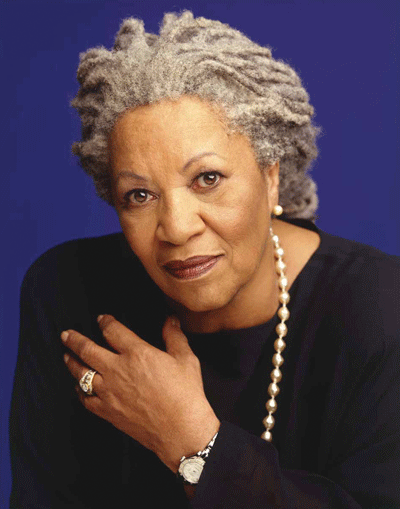
Toni Morrison: Will you teach at my imaginary school?


 I tell my students, ‘When you get these jobs that you have been so brilliantly trained for, just remember that your real job is that if you are free, you need to free somebody else. If you have some power, then your job is to empower somebody else. This is not just a grab-bag candy game.
                        - Toni Morrison          

Yesterday I stumbled upon this quote from Toni Morrison and I was blown away by the simplicity of her insight.  I mean, as if I needed any more reason to love this woman, as if she hadn’t already earned her spot on the Wall of Writers in my classroom (right between Gwendolyn Brooks and Anne Frank) several times over.  She is clearly one writer/ teacher who walks the walk.    

Her message, so beautiful and simple as only she could state it, “If you have some power, then your job is to empower somebody else”, is a message too often forgotten.  There is a “I’m just trying to get mine” mentality that is pervasive with students today and this mentality comes from the folks who teach them, both directly and indirectly.  I believe it is this selfishness that has led to much of the inequity and disparity that exists within our educational system.  Politicians and “reformers” are quick to decide what is “best” for disenfranchised populations without considering what effects these changes might have on the population.  Few of these reforms truly consider how to EMPOWER students, parents, and communities. 

Also endemic to this reform mindset is an undertone of blame. The rhetoric around The Achievement Gap, Failing Schools, AYP, Takeovers, Turnarounds, Persistently Dangerous, and No Excuses all suggest a subtle (or sometimes not so subtle) blaming of the students and their communities.  Earlier this year there was a piece in Forbes that gained some attention called “If I were a poor black kid”.  I’ll be optimistic and assume that writer Gene Marks’ goal was not to further dis-empower children growing up in poverty, but to demonstrate the potential that technology holds for the expansion of knowledge.  His conclusion, however, makes that a difficult argument to accept, as he speaks directly to this blame mentality.

“Technology can help these kids. But only if the kids want to be helped. Yes, there is much inequality. But the opportunity is still there in this country for those that are smart enough to go for it”. 

In truth, there is plenty of responsibility to go around, but dwelling on it does little to EMPOWER students and communities. 
                                                                                                                                    

During summer school I worked with a text that I feel embodies the mission of empowerment that Toni Morrison is suggesting.  In The Other Wes Moore, author (Hopkins’ alum, Rhodes Scholar & US Army Captain) Wes Moore parallels his experience with that of the “other Wes Moore”, a man who grew up in the same neighborhood, at the same time, under similar circumstances, with the same name who is currently incarcerated for his role in an armed robbery and murder. 
 
The text really spoke to my students primarily for what it is NOT.  It is not a prescription for how they should live.  It is not a preachy text espousing that education is a magic potion that will lead you out of the ghetto (though Wes does stress the importance of education).  It does not ignore the realities of growing up in concentrated, generational poverty. In other words, it doesn’t say “NO EXCUSES”.  From my interactions with Wes, I’m certain that he is not “Pro-Excuses”, in fact he’s probably the last person who would make excuses for anything as he stresses personal accountability, but he does recognize realities.  He acknowledges his own struggles and advantages and attempts to EMPOWER others though sharing his experience. 

Our first of two new-student orientations is this afternoon and I’m excited to see 60 new faces who will join our program in a few weeks.  What makes me even more excited, however, are the folks who accompany them, the parents (especially the fathers), grandparents, advocates, siblings, children, and friends who support our students in their academic endeavor.

 I have the utmost respect for the students who walk through our doors.  I can only imagine what it’s like to walk into a school at 19, 20 or 21 years old with less than 5 credits (of the 23.5 necessary to graduate).  These are the students I am committed to serving and I will keep Wes’s story and Toni Morrison’s words in mind as I address and welcome our new students this afternoon. I will keep these words with me all year, especially when things get though (as they always do). 

Tuesday, August 21, 2012

3 Simple Steps to Restoring Sanity to Schools


MacArthur "genius" award recipient and educational scholar Lisa Delpit is perhaps most famous for her book Other People’s Children, which focused on the cultural struggle that goes on in many urban classrooms when white, middle-class teachers fail to acknowledge the unique experiences of their students and instead try to force their own beliefs and cultural norms. I have found her writing to be  eye-opening and it has certainly impacted my work in the classroom (as a white, middle-class man teaching in a high-poverty, black school).   

As I was reading her recent work, Multiplication is for White People: Raising expectations for other people’s children, her “Three Steps toward Sanity” struck me as a simple and straightforward (at least to educators) roadmap for improving educational opportunities for urban students.  These steps have nothing to do with funding, school structure, politics, administration, charters, vouchers, or any other foolishness.  They are the backbone of successful education systems for which she’s suggests a renewed focus.

1. Believe in the Children
“I believe the first step [to educating children that school systems have typically failed] is to become convinced of these children’s inherent intellectual capability, humanity, physical ability, and spiritual character. Unfortunately, our nation’s educational enterprise continues to be obsessed with the notion of intellectual capacity” (Delpit 30).

It is nearly impossible to argue with this first step to building strong schools and it seems so simple. Almost every school and organization that claims to serve an educational purpose has some variation of “we believe all children can learn” in its mission statement.  However, saying “I believe all children can learn” is not the same as “believing in children”, at least not in my opinion.

When schools say “We believe all children can learn”, there is an implication that comes at the end of the statement.  What typically goes unsaid is something like “in spite of their skin color or parents or neighborhood”.  This implication leads to the same type of deficit mindset as the “achievement gap” language (as Gloria Ladson-Billings argues). Whether implicitly or explicitly, it sets a certain group of children apart from others and serves to reinforce stereotypes. 

Students don’t need that teacher who comes in on their high horse saying, “I’m going to tell you that you have potential because no one has ever told you that before”. In making such a statement (as is often espoused by organizations such as TFA and StudentsFirst), teachers have already passed judgement on their students and their communities. Students need a teacher who truly believes in the innate abilities that all children possess, not against the odds or in spite of who they are, but simply by virtue of being human.      

2.  “Fight Foolishness”
Citing a phrase from Professor Emeh, Delpit suggests that to educate children who we (as a society) have previously failed, we as teachers, schools, and society must “fight foolishness”. 

“We have to cease attempting to build ‘teacher-proof’ schools with scripted low-level instruction and instead seek to develop (and retain) perceptive, thinking teachers who challenge their students with high-quality, interactive, and thoughtful instruction” (Delpit 34). 

I cannot agree more with Delpit’s second directive.  In schools, particularly urban schools, there are mountains of “foolishness” that influence what the teachers teach and, coincidentally, what the students experience. This foolishness takes the form of everything from scripted curricula and prescriptive programs to zero tolerance policies and complex school-wide reward/ punishment systems.  While some of these initiatives find success in some schools, they cannot be seen as a panacea in all impoverished populations.

Delpit stresses, “Successful instruction is constant, rigorous, integrated across disciplines, connected to students’ lived cultures, connected to their intellectual legacies, engaging, and designed for critical thinking and problem solving that is useful beyond the classroom” (37). If ever there was a concise definition of what great teaching should be, that’s it. As I retool and revisit my syllabi for the coming school year, I will keep this sentence in mind, ensuring that my goals, particularly in working with my specific population (over-aged, under-credited), are in line with supporting my students’ all-around growth and development.   


3.  Learn who our children are and discover the legacies they bring
“If we are truly to educate poor African American children, we must learn who the children are and not focus on what we assume them to be - at risk, learning disabled, unmotivated, defiant, behavior disoriented, etc. This means developing relationships with our students and understanding their political, cultural, and intellectual legacy” (38).

Delpit’s final directive speaks directly to the human side of teaching and education. It builds off of the discussion of fighting foolishness, as the foolishness in schools often does little to acknowledge who students are.  Throughout my undergraduate, student teaching, graduate, and independent work, I have read a variety of articles and texts suggesting how best to teach specific kinds of students. However, each one of these texts reduces students to labels or tropes.   
Books often offer tips like: 
- “When you have a disruptive student, give them a job in the classroom” 
or 
- “In teaching at-risk students, use hip hop to make the lessons more interesting”.   

While these tips are successful in SOME classes with SOME students, it is unfair and unrealistic to suggest that all at-risk (a term that I find troubling to begin with) students, for example, will succeed with the simple inclusion of hip hop. Instead, just as Delpit suggests, it is essential for teachers to build relationships and understand where their students are coming from. 

I had a very telling experience with this in my first year of teaching when a student said something about how crazy the white people in the KKK were, then turned to me and said, “No offense”.  Before I could reply (and explain that I don't identify with the KKK and therefore don't take offense to suggests that their actions are crazy), another student jumped in and said, “Don’t worry, Teacher Man isn’t white, he’s Italian”.   

The rest of the class agreed and was ready to move on.  I wasn’t.  The interaction was confusion to me and I asked why they thought I wasn’t white. They explained that I didn’t do the things that white people did.  They explained that I listened to them, understood their references and experiences, joked with them, and respected them.  My students (who are almost all black) had a specific definition of “White Male” and I didn’t fit, therefore I must not be white. Looking back, it was pretty sound reasoning. 

I offer this story to say that it is crucial that teachers in all settings, but especially in urban classrooms where their experiences may be very different from their students, work to understand the issues, experiences, and challenges students face.  Though there are many cultural differences between the population that I serve and myself, that doesn’t stop me from trying to understand their individual experiences and tailoring my instruction to fit those legacies.  . 

I know that I will keep these three steps in mind as I head back in to school tomorrow.  We have two weeks of teacher prep and I’ll be sure to share these with my colleagues as we prepare for the coming year. 

Thursday, August 16, 2012

TFA and assumptions about poverty

 
I read a well written piece on Reuters today that I feel outlines many of my fundamental concerns with TFA.

*Before I begin on what might come off as “TFA Bashing” (but in my opinion is not), I should say that I take issue with what the organization has become and the agenda that I feel they are pushing, not with individual corps members who are  following their training and supervisors.  I have a number of friends who have done TFA (with mixed reviews) and I’ve worked with a handful of corps members and alums.  

That said, in the interest of full disclosure, here is my personal background with TFA:
I went to a small, “highly selective” liberal arts school where TFA recruited heavily. They employed students, typically NOT education minors (in the teacher ed program you majored in your subject and minored in ed.) to speak to classes and recruit students to apply to the program.  Knowing I had been involved with a number of mentoring and teaching programs, I got calls from the recruiters, but after I told them I was committed to student teaching and the “traditional route” they left me alone. 

From my graduating class of about 700 students (I know, small), 6 students joined TFA.  Of those six, 1 quit during institute, 2 left after their first year, and 3 completed their 2 year commitment.  Also, according to the most recent college alumni magazine one of those 3 is now “one of the youngest principals in the country” (which is a whole separate concern for me). 

While these six students were completing their summer institutes in urban districts around the country, I was applying to and interviewing at schools all over Philly.  At almost every school, they asked disappointed, “So you aren’t TFA?” As though doing my student teaching and being fully certified was some sort of black mark on my application. In spite of my frustration, I ultimately found a job working at an alternative school, so no harm done.  I offer this personal account to show that even for traditionally trained novice teachers there is an “us vs. them” dichotomy set up with TFA. 

Though I have a host of other concerns with the present iteration of TFA, one particular quote from Stephanie Simon’s piece on Reuters jumped out at me.  A 22-year-old recruit who will be teaching in LA said, “I’m here to tell these kids that they have potential. They’ve never been told that before”.  The second sentence really rubbed me the wrong way.  Though I don’t think this well meaning recruit intended to insult the population of students that they’ll be teaching in the fall, it certainly struck me that way.

 If I’ve learned anything from teaching so-called “dropouts” for the last three years, it’s that you can’t make any assumptions about the students, their families, or their experiences.  Saying that students have never been told that they have potential is an assumption that people make about kids in poverty (and their families) and these assumptions are dangerous.  See the criticism of Ruby Payne’s “A Framework for Understanding Poverty”.  Teachers and districts love people like Payne who offer a step by step outline for how to teach poor kids.  The reality, however, is that there are no step-by-step directions.  In her book, which served as a great counter example in my urban ed classes, Payne makes generalizations and assumptions about children in poverty that I found shocking and absurd.  Further, even if her assumptions held true, I didn’t find them to be particularly helpful to my teaching. 

I feel that in its rush to “prepare” recruits for the classroom, TFA has drawn on the work of people like Payne who offer quick fixes to working with children in poverty.  This approach leads recruits to make assumptions that could ultimately make their work in the classroom even more difficult and be potentially damaging to their students.